
- What is LoRa®?
LoRa® is a long-range wireless technology in which each binary 0 and 1 to be transmitted is transmitted as a frequency pattern (spreading arc). While this increases the protocol length and therefore the transmission time, it allows the signal to be filtered and received as an extremely weak signal using special techniques. It was developed by the company Semtec. LoRa is suitable for transmitting small amounts of data per unit of time.
- What is LoRaWAN®?
IBM designed a network protocol specifically for wireless IoT. LoRa® was selected as a suitable transmission method, resulting in LoRaWAN®. LoRaWAN® is bidirectional and operates in Class A, B, and C modes. In Class A mode, the LoRa device is asynchronous to the network. In Class B mode, the device maintains synchronization with the network through short synchronization windows. In Class C mode, the device is always wirelessly connected to the network. The energy required for operation increases from Class A to Class C; Class C is only practical when powered by mains electricity.
- Advantages of LoRaWAN®
The advantage of LoRaWAN® long-range radio technology is that the user is not dependent on an existing receiving network. Users can install and operate one or more LoRaWAN® gateways themselves. A network server is required to operate a private network. Users can set up and operate the server themselves using free software or utilize various network platforms such as TTN, MATCHX, or LORIOT. LoRaWAN® data traffic is bidirectional and uses double encryption (user data and network protocol). LoRaWAN® can only transmit small amounts of data per unit of time. However, the transmission method developed by SEMTECH, in conjunction with the IBM network protocol, enables data transmission over greater distances. The radio protocols themselves range in duration from a few milliseconds to a few seconds. Further information can be found here.
- Using LoRaWAN® in metering
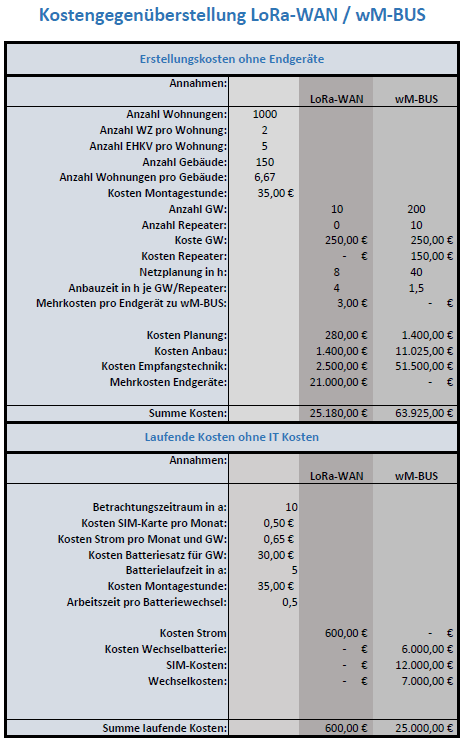
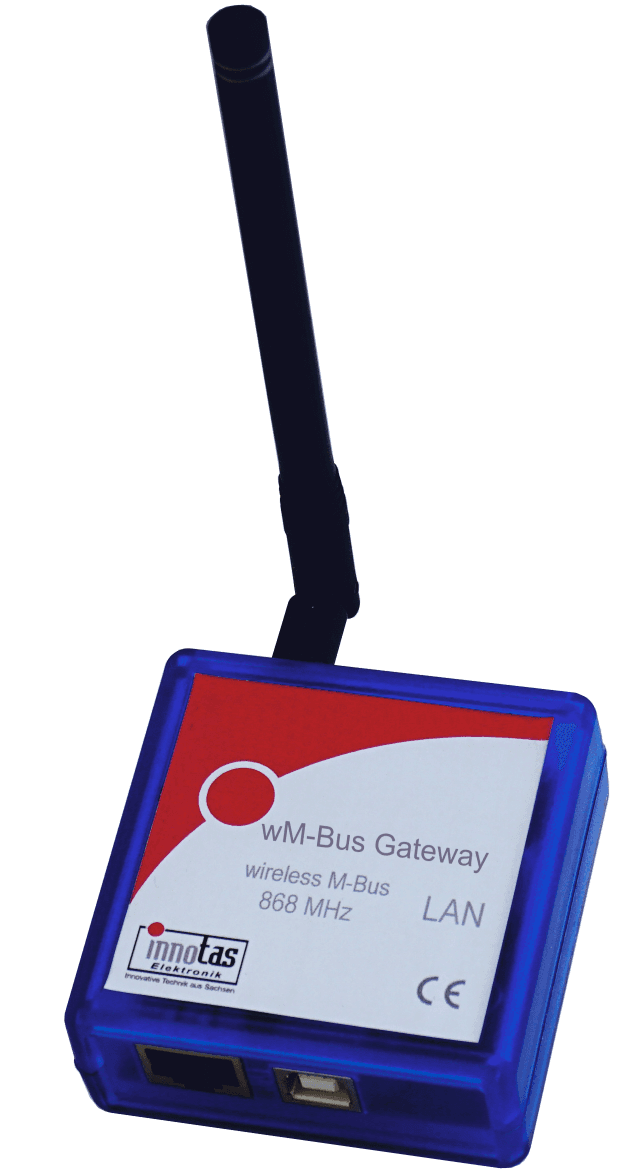
Since LoRa has a much greater range and thus a much larger area coverage per receiver (gateway) in the metering area (wM-BUS) compared to previous radio technologies, lower system costs are necessary. Far fewer receivers (gateways) need to be installed. The operation of expensive battery-powered wM-BUS gateways is also eliminated, reducing planning and installation costs. Sample calculations show that these costs can be reduced by up to 10%. In a multi-story residential area, instead of installing multiple wM-BUS gateways at each building entrance, only a few LoRa gateways are needed for the entire area.
- Does a dedicated LoRa network make sense?
There are network providers that operate open LoRa networks where you can integrate your own gateways. With fixed networks, there's a risk of insufficient coverage in some areas. However, the advantage of this technology is the ability to build and operate your own network. The following article explains how to set up your own open-source LoRa network server on Azure.